 Startpage
Contemporaries in the Holy Roman Empire
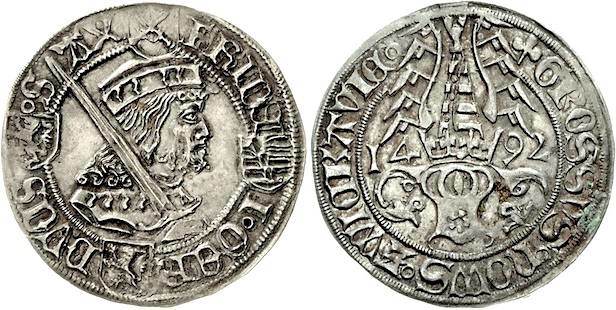
Bartgroschen 1492, Zwickau. Ø 25 mm, 2,40 g. Krug 1869; Levinson I292; Schulten 2972. Obv.: FRIDEricus - I◦GEoRgius - DVCeS - ◦S AXoniae Bust in electoral coat with sword on his right shoulder. Rev.: ♣ GROSSVS◦nOVVS◦ZWICKAVIE◦ - helmet with Saxon crest between date 14 - 92. ♣ stands for mint master Augustin Horn. This is the first Saxon coin showing a personalized portrait of a ruler.
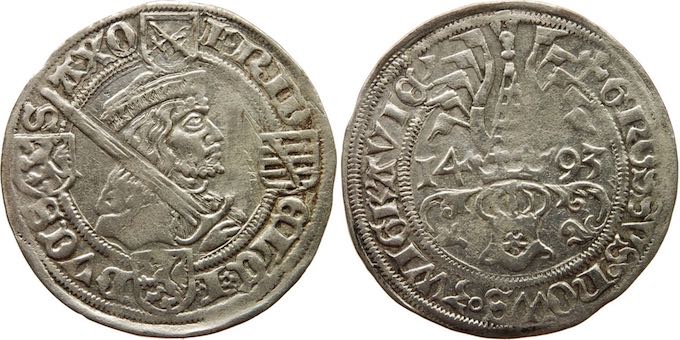
Bartgroschen 1493, Zwickau. Ø 26 mm, 2,50 g. Specimen from Coincabinet of Staatliche Kunstsammlungen Dresden 
Similar as before.
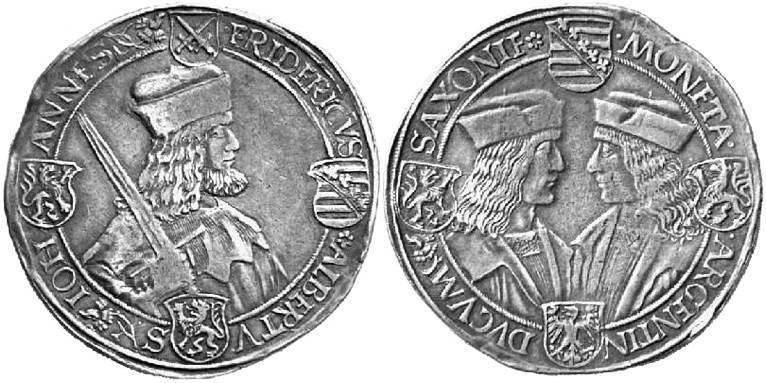
Guldengroschen (1st "Klappmützentaler"), n. d. (1500), Annaberg. Ø 43 mm, 29 g. Schnee 1; Keilitz 4; Dav.9705 Obv.: FRIDERICVS - ¤ALBERTV - S Ꮺ IOH - ANNES Ꮺ - "Frederick Albert John" with the arms of the Electoral Duchy of Saxony (top), Duchy of Saxony (right), Meissen & Thuringia (left). Bust of Frederick in electoral coat with the electoral sword on his right shoulder.
Rev.: ·MONETA· - ·ARGENTIN - DVCVM Ꮺ - SAXONIaE¤ (...TIN incorrect for ...TEA)
"Silver money from the Duchy of Saxony" interrupted by the arms of Saxony, Meissen, Palatinate Saxony and Thuringia. Busts of dukes Albert and John facing each other and wearing hats with foldable rims. Albert the Courageous, the founder of the Albertine line of the House of Wettin, war Frederick's uncle. John the Steadfast was Frederick's youngest brother, co-regent und his successor.
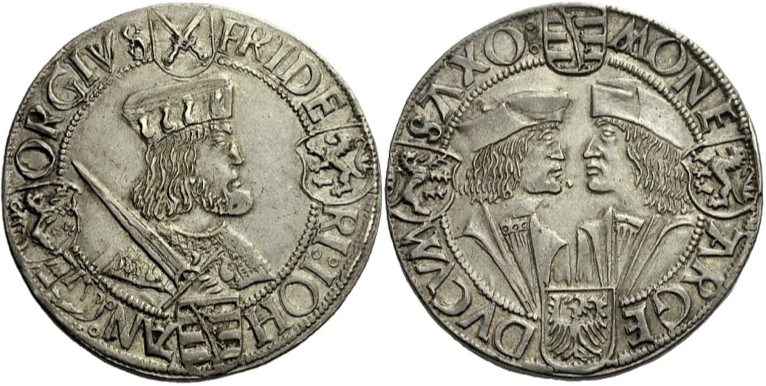
Guldengroschen ("Klappmützentaler") n. d. (1507-25), Annaberg. Ø 41 mm, 29,20 g. Legends with large letters in antiqua. Schnee 18; Keilitz 43; Dav.9709. Obv.: FRIDE - RIcus⦂IOH - ANnes⦂GE ORGIVS - effigy of Frederick III to the right. Rev.: MONEta - ARGEntea - DVCVM - SAXOniae - effigies of George and John en face. Both sides have a Central dot.
This is an extraordinary well stuck piece. The Klappmützentaler were not issued for representation but for circulation, in order to exploit the rich silver yield of the Saxonian mines.
Frederick as "Imperii locum tenens generalis" (Governor General in the Empire) 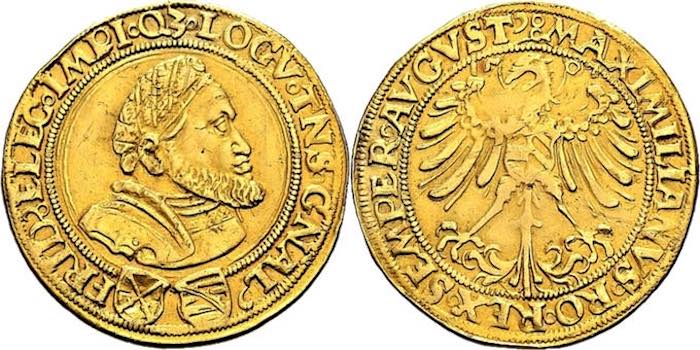
Double gold florin 1507 (1508), Nuremberg. Ø 26 mm, 6,29 g. Keilitz 67; Friedb.2934. On the governorship in the empire, granted by emperor Maximilian in 1507. Obv.: FRIDEricus'◦ELECtor◦IMPeriI◦Que3◦LOCVm◦TeneNS◦GeNerALis' Bust to the right, in armor with wire hood, below electoral coat of arms and coat of arms of Saxony. Rev.: ⦂MAXIMILIANVS◦ROmanorum◦REX◦SEMPER◦AVGVSTus' Single headed eagle with breast shield (Austria/Burgundy), nimbed eagle head between date 15 - 07.
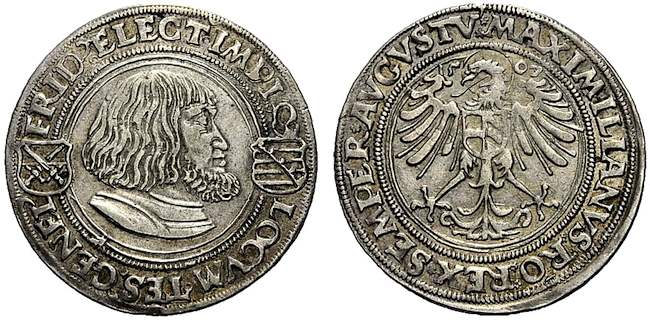
Schreckenberger 1507, Nuremberg. Ø 25 mm, ca.4,5 g. Keilitz 79; Schulten 3031. on the dignity to be governor-general of the empire in the absence of emperor Maximilan. Obv.: FRIDericus'ELECTor◦IMPeriI⦂Que3 - LOCVM◦TEnenS⦂;GENEraLIs' bearded bust with long hair to the right; arms of Electorate and Saxonia in the legend. Rev: MAXIMILIANVS◦ROmanorum◦ REX◦SEMPER◦AVGVSTVS - royal eagle with shine, shield of Austria-Burgundy on the breast, on top the date 15 - 07.
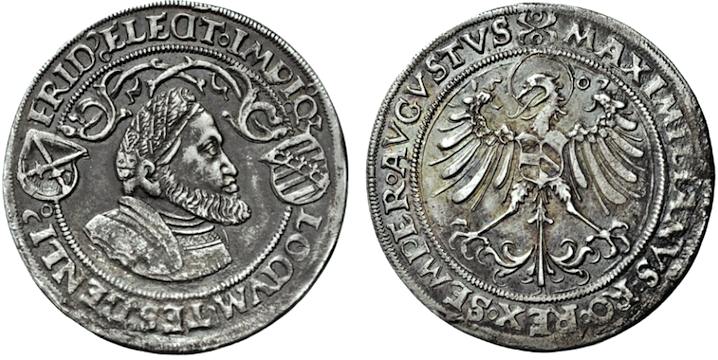
1/4 Guldengroschen 1507, Nürnberg. Ø 29 mm, 6,99 g. Keilitz 73; Schulten 3029, on the dignity to be governor-general of the empire in the absence of emperor Maximilan. Obv.: FRID'◦ELECTtor◦IMPeriI⦂Que3 - LOCVM⦂TEnenS⦂GENeraLIs'◦ bearded bust with hood of wire to the right; arms of Electorate and Saxonia in the legend. Rev: MAXIMILIANVS◦ROmanorum◦ REX◦SEMPER◦AVGVSTVS - royal eagle with shine, shield of Austria-Burgundy on the breast, on top the date 15 - 07.
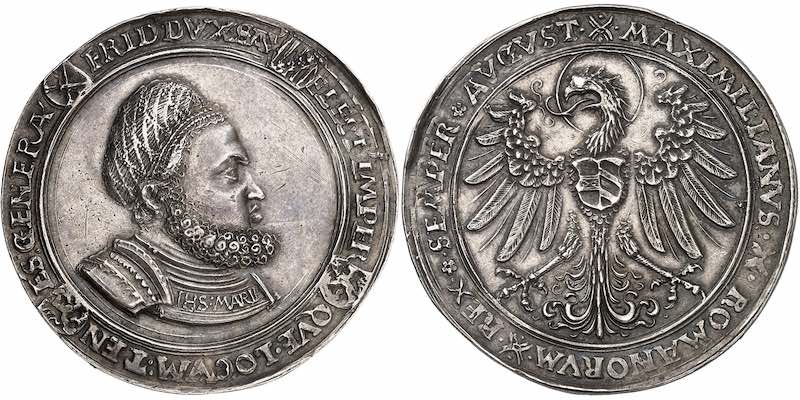
Broad Guldengroschen n. d. (1512), Hall dies by Ulrich Ursenthaler. Ø 45 mm, 28,69 g. Keilitz 70.2; Schnee 37. On the governorship of the Elector, awarded by Emperor Maximilian in 1507. Obv.: FRID' DVX᛫SAX'(1)ELECT'᛫IMPER(2)QVE᛫LOCVM:TEN(3)E'S:GENERA'(4) with the coats of arms: 1=Electoral Saxony, 2=Saxony, 3=Meißen, 4=Thuringia. Armored bust to the right with wire cap, on the chest: IHS:MARIA Rev.: ᛫MAXIMILIANVS᛫ (decoration) ᛫ROMANORVM᛫ (decoration) ᛫REX᛫*᛫SEMPER*AVGVST᛫ Imperial eagle, the head to the left; on the chest coat of arms Austria/Burgundy.
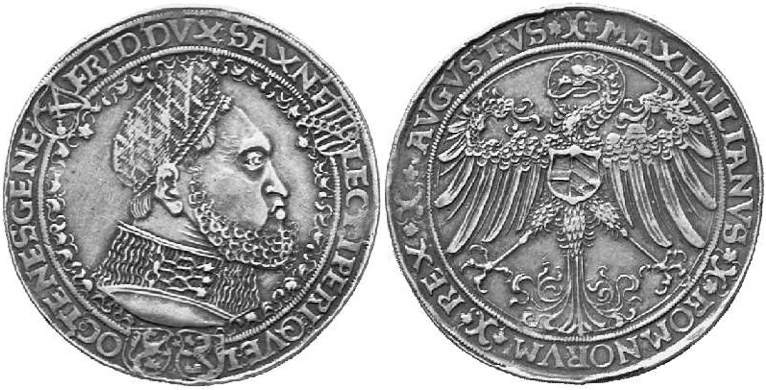
Guldengroschen, n.d. (1513), Nürnberg. Ø 43 mm, 28,6 g. Schnee 39; Dav.9702. Obv.: FRIDericus DVX:SAXoNiae:E - LECTor:ImPERIi:QVE:L - OCum TENEnS·GENEralis "Frederick, Duke of Saxony, imperial elector, Emperor's governor"
Rev.: MAXIMILIANVS·×·ROMANORVM·×·REX·×·AVGVSTVS·×·
between arms of the Electoral Duchy of Saxony, Duchy of Saxony, Meissen and Thuringia. Imperial eagle with shine and shield of Austria-Burgundy on the breast.
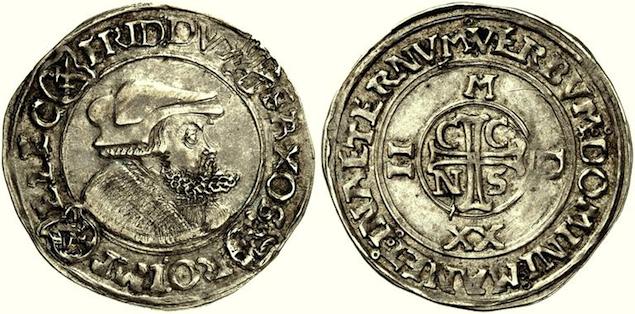
Schreckenberger 1522, Nürnberg. Ø 31 mm, 4,30 g. Keilitz 81. FRID:DVX - SAXOS - RO.IMP - ELEC // VERBVM:DOMINI:MANET:IN AETERNVM similar to next.
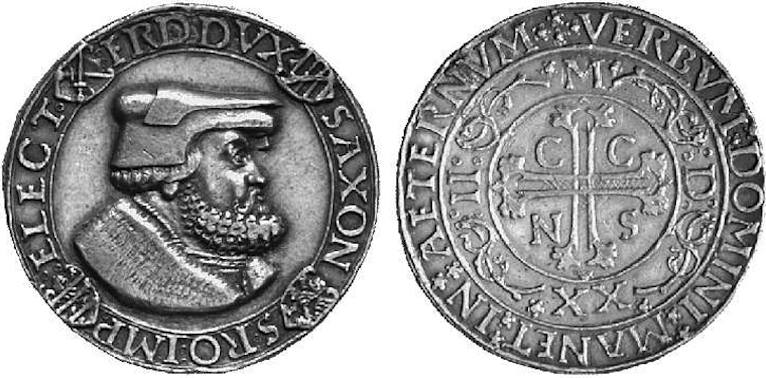
Guldengroschen, 1522. Ø 42 mm, 25,99 g. Schnee 43; Dav.9704 Obv.: FRiDericus·DVX - SAXONiae - Sacri·ROmani:IMPerii - ELECTor - Rev.: +VERBVM.DOMINI:MANET:IN:AETERNVM. "The word of the Lord is eternal" Cross with flowered ends, in the angles C-C-N-S (Crux Christi Nostra Salus = "Christ's Cross is our salvation") surrounded by the date M - D - XX - II with ornaments between the letters.
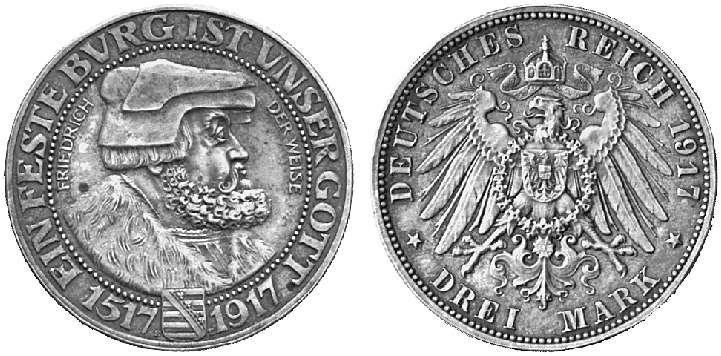
3 Mark 1917, Muldenhütten. Ø 33 mm, 16,67 g. Jäger 141 Obv.: EIN FESTE BVRG IST VNSER GOTT 1517-1917 / FRIEDRICH - DER WEISE "A Mighty Fortress is Our God" (the best known of Martin Luther's hymns)
Rev.: DEUTSCHES REICH 1917 ¤ DREI MARK ¤
|

| enlarged: 9.2017 |
